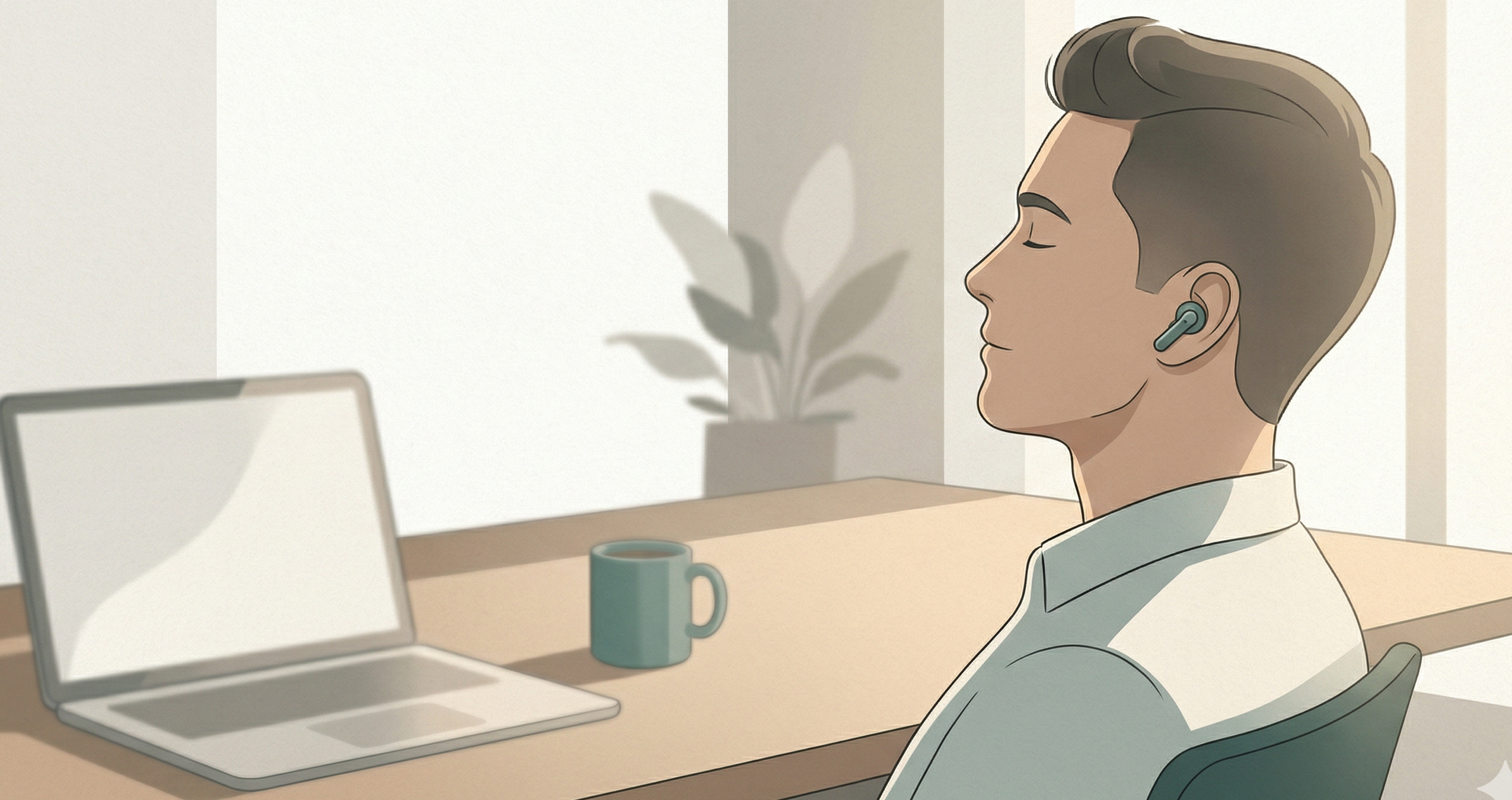
Guided meditation is the easiest way to start meditating at work. Someone else does the thinking. You just listen and follow along. For busy people who cannot quiet their own mind between meetings, that makes all the difference.
Maybe you have tried meditation before and gave up because you felt like you were doing it wrong. Or maybe you have always been curious but never knew where to start. Either way, guided meditation removes the biggest barrier: the feeling that you need to already know how to meditate in order to meditate. You do not. You just need earbuds and a few minutes.
What is guided meditation?
A guided meditation is a session where a voice talks you through the experience. The guide tells you what to focus on, when to breathe, and how to handle the distractions that inevitably show up. Instead of sitting in silence wondering if you are doing it right, you have someone walking you through each step.
This is what makes it so accessible. Unlike self-directed meditation, you do not need to know any techniques. You do not need to have practiced before. You do not need to clear your mind on your own. The guide handles the structure so you can just show up and follow along.
Think of it like the difference between going to the gym alone for the first time versus working with a trainer. The trainer tells you what to do, keeps you on track, and makes sure you are getting something out of it. Guided meditation works the same way. It takes the guesswork out entirely.
Why guided meditation works well at work
There are a few reasons guided meditation is particularly well suited to the workplace, even more so than other forms of mindfulness practice.
Your mind is already busy. After a meeting, your brain is full of decisions, conversations, and to-do items. Asking yourself to just "be present" in that state is a tall order. A guide gives you something specific to focus on, which makes it much easier to shift out of work mode, even briefly.
Short sessions still work. A guided meditation of three to five minutes can be genuinely effective because the guide keeps you focused the entire time. There is no warm-up period where you spend three minutes trying to settle in. You are directed from the first breath. Research from Microsoft's Human Factors Lab found that guided meditation breaks between meetings were enough to reset accumulated stress, preventing the buildup that makes afternoons feel so draining.
Earbuds make it invisible. Nobody needs to know you are meditating. Put your earbuds in, close your eyes for a few minutes, and you look like someone taking a brief pause between calls. There is no special equipment, no app on a shared screen, nothing that draws attention. It is completely discreet.
Guided meditation vs unguided meditation
Both guided and unguided meditation are valid practices, and neither is inherently better than the other. They serve different purposes at different times.
Guided meditation tends to be better when you are a beginner, when your mind is especially busy or distracted, or when you are dealing with work stress or anxiety. The external voice gives your attention something to anchor to, which is exactly what you need when your thoughts are racing.
Unguided meditation works well once you have some experience and want more flexibility. You might prefer silence, or you might want to sit for longer without someone talking. Many people find unguided practice more natural at home or in calm environments where they are not competing with a busy mind.
A lot of people use both. Guided at work, where the mental noise is high and the windows are short. Unguided at home, where there is more space and less urgency. There is no rule that says you have to pick one. Use whatever helps you actually do it.
How to fit guided meditation into your workday
The most common objection to meditation at work is time. People feel like they do not have any. But the truth is, most workdays already contain small gaps that go unused. You do not need to create new time. You need to notice the time you already have.
After meetings end. This is the single best moment for a guided meditation. Your stress is highest right after a demanding call, and even a short session between meetings can reset your state before the next one begins. The gap is already there. You just need to use it.
Before an important call. If you have a difficult conversation coming up, a three-minute guided session beforehand can help you walk in calmer and more collected. It is preparation that does not look like preparation.
During lunch. Even five minutes in the middle of the day can split your workday into two halves that each feel fresh, rather than one long grind from morning to evening.
End of day wind-down. Before you close your laptop, a short guided session can help you transition out of work mode so you are not carrying the day's tension into your evening.
The key insight from habit research is that anchoring a new behavior to an existing cue is far more effective than trying to schedule it from scratch. "After my standup ends" is a stronger trigger than "sometime around 11 a.m." Your calendar already provides the cues. Use them.
What to look for in a guided meditation for work
Not all guided meditations are built for the workplace. A twenty-minute body scan designed for bedtime is not going to help you in the six minutes between your team sync and your next one-on-one. Here is what matters when choosing guided meditation for work.
Short duration. Look for sessions in the three to seven minute range. That is long enough to be meaningful and short enough to fit into real gaps in your day.
Mood-relevant content. What you need after a stressful call is different from what you need when you are tired and unfocused. The best guided meditations match the session to how you are actually feeling, rather than offering a one-size-fits-all script.
Low friction. If you have to open an app, browse a library, pick a category, choose a teacher, and then start, you have already lost the moment. The fewer steps between "I have a gap" and "I am meditating," the more likely you are to actually do it.
Schedule awareness. Ideally, you want something that knows when your meetings end and how much time you have before the next one. That way you do not have to think about timing at all. Mellem takes this approach. It sits in your Mac menu bar, watches your calendar, and suggests a guided session that fits the gap between your calls. You do not have to browse or choose. It just arrives at the right moment with the right length.
Getting started
You do not need to read another article, buy a cushion, or wait for the right moment. Start today.
Look at your calendar. Find one gap between meetings. It can be five minutes. It can be three. Put your earbuds in and try a short guided session. That is it.
Do not worry about whether you are doing it right. Do not worry about whether your mind wanders. It will. That is normal. The guide will bring you back. That is the whole point.
The people who benefit most from meditation at work are not the ones who are naturally calm or spiritually inclined. They are the ones who decided to try it once, noticed they felt a little better afterward, and then did it again the next day. The bar is that low.
If you want to go deeper, our meditation at work guide covers everything from building a daily habit to choosing the right approach for your schedule. And if you are curious about how different apps handle workplace meditation, our comparison guide breaks down the options.
But for now, just start with one session. Three minutes. Earbuds in. Eyes closed. Follow the voice. See how you feel afterward.